5 Questions with Dr. Richard Andreatta: Exploring the third edition of his neuroscience textbook
Nov 2, 2026
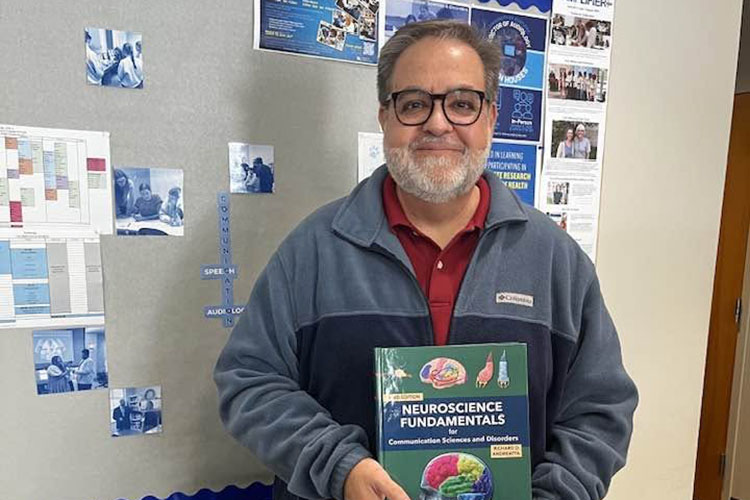
By Ryan Clark
CHS Communications Director
For Dr. Richard Andreatta, understanding the brain and nervous system is about much more than studying individual structures and pathways. It's about understanding how those systems work together to shape human behavior, communication and, ultimately, the way we interact with the world.
That philosophy is at the heart of the third edition of Neuroscience Fundamentals for Communication Sciences and Disorders, recently released by Andreatta, PhD, ASHA Fellow, professor in the University of Kentucky's Department of Communication Sciences and Disorders (CSD) and Rehabilitation and Health Sciences Doctoral Program (RHB).
Andreatta, who also serves as CSD's director of undergraduate studies and the College of Health Sciences' director of undergraduate research, has significantly expanded and updated the latest edition. The book features a new chapter on the neural mechanisms of speech and language, approximately 45 clinical case studies, updated figures, expanded discussions of sensory and motor systems, and an extensive collection of student learning resources.
More importantly, the latest edition continues Andreatta's emphasis on connecting fundamental neuroscience concepts with real-world clinical applications, helping prepare future professionals in fields such as speech-language pathology and audiology.
Lindsey Jorgensen, AuD, PhD and chair of the Department of Communication Sciences and Disorders, said the book reflects both Andreatta's expertise and the department's commitment to providing students with a strong educational foundation.
"Dr. Andreatta’s third edition gives our students a text built on the same brain and behavior thinking we teach across the CSD program, and it shows the depth of expertise we have in this department," she said. "When our faculty write books that students across the country will read, it says a lot about the quality of the people teaching here. He is a true asset to the department and the book serves as a resource for students to use while here and one they will use long after they graduate."
We recently caught up with Andreatta to discuss what inspired the newest edition, how neuroscience continues to evolve, and what he hopes students carry with them as they prepare for careers helping others.
1. What prompted you to develop a third edition of Neuroscience Fundamentals for Communication Sciences and Disorders, and what are the most significant changes readers will find compared with the previous edition?
Neuroscience continues to evolve, and with each new edition, my goal is to incorporate important advances in our understanding of the nervous system while improving how this material is presented to students.
The third edition was completely reorganized to improve the flow and sequencing of the content. It includes a new chapter devoted to the neural mechanisms of speech and language, the addition of approximately 45 clinical case studies, updated figures, more tables, and expanded discussions of sensory and motor systems.
In all my revisions, I've placed greater emphasis on connecting basic neuroscience principles with clinical applications. Lastly, the book includes a much larger collection of student learning resources, such as mind maps, study guides, videos, and something I call "Explain It To Me Simply" (ETMS) topic summaries. The ETMS topic summaries are short handouts that try to simplify more of the technical and complex topics in the various chapters.
Overall, these resources are designed to help students understand and apply what they are learning more effectively.
2. What do you hope this book helps students understand about the relationship between the brain, the nervous system and human communication?
One of the most important things I want students to understand is that human communication depends on the coordinated activity of many different neural systems.
We often teach neuroscience by dividing the nervous system into individual structures and pathways, which is necessary when learning the material initially. However, these systems do not function independently. Speech, language, hearing and swallowing depend on the continuous interaction of sensory, motor and cognitive processes.
I want students to intuitively understand how these systems are organized, how they work together, and how their interactions ultimately give rise to human communication. I've always taken a "brain and behavior" approach to developing and refining each edition, a tradition that I continue to employ.
3. How has our understanding of the brain and nervous system evolved since the previous edition, and how have those advances influenced the content or approach of this new edition?
I think one of the most important developments in neuroscience has been our growing understanding of how different neural systems interact to produce behavior.
We have moved beyond thinking about individual brain regions as having relatively isolated functions toward a greater appreciation of distributed neural networks and the importance of sensorimotor integration. As I emphasize to my students, connectivity between brain regions is the key factor underlying what we appreciate as adaptive and functional behavior.
We also have a much better understanding of how experience and behavior influence neural organization and function. These ideas are emphasized throughout the third edition, particularly in discussions of speech production, sensory processing, motor control and neuroplasticity.
4. For students preparing for careers in fields such as speech-language pathology and audiology, how does a strong foundation in neuroscience translate into better clinical decision-making and patient care?
I believe understanding the neuroscience underlying human communication is essential to developing strong clinical reasoning skills.
It is one thing to recognize the symptoms associated with a communication disorder, but it is another to understand why those symptoms occur. When students understand the neural mechanisms underlying normal function, they are better prepared to recognize what happens when those systems are damaged or disrupted.
This knowledge provides a foundation for interpreting clinical findings, making informed treatment decisions, and understanding how rehabilitation can influence neural function and behavior. I believe neuroscience training contributes to the metacognitive awareness clinicians need to deeply understand and evaluate their treatment goals, strategies and assessments.
5. When students finish reading this edition, what is one concept, perspective or takeaway you most hope they carry with them into their future careers?
If there is one concept I hope students take away from this book, it is that the nervous system is not a static structure. It is a dynamic and emergent biological system that continually responds to and adapts to our environment, experiences and behaviors.
This appreciation matters especially for students entering clinical professions because it lays the foundation for understanding the neurobiological basis of rehabilitation. The activities we engage in, including therapeutic ones, directly influence how neural systems are organized and how they function.
Ultimately, and quite simply, I want students to appreciate that behavior changes the nervous system, and that changes in the nervous system influence behavior.
BONUS: Writing a third edition of a textbook represents a significant investment of time and expertise. What has been the most rewarding part of seeing this book evolve, and what does this latest edition represent for you as an educator and researcher?
As an educator, the book is an opportunity to teach students well beyond the walls of this university. It is a chance to help anyone who reads the book understand something that I find so exciting and interesting to discuss with anyone who will listen.
As a researcher, the book offers a unique opportunity to intensely use and refine my scholarship skills in a way that writing a journal manuscript cannot. The freedom to expound on an idea with as much explanation as needed to make a point crystal clear is very satisfying for someone who enjoys writing and explaining complex ideas.
The most rewarding part of the book's journey through multiple editions is seeing how it gets progressively closer to the ideal I have in mind ... and, of course, seeing my name on the cover is always kinda cool, too.