CHS researcher tackles joint injuries with $4.6M in new grants
Oct 15, 2026
By Christian Honce
UKNow
LEXINGTON, Ky. (Oct. 15, 2026) — In the Commonwealth, musculoskeletal injuries are the leading sources of disability and chronic pain, a crisis intrinsically linked to the ongoing opioid epidemic. These injuries range from anterior cruciate ligament (ACL) tears and bone fractures in younger people to arthritis in the later years. At the University of Kentucky, researchers launched two major studies aimed at reversing these trends through innovative, multidisciplinary rehabilitation.
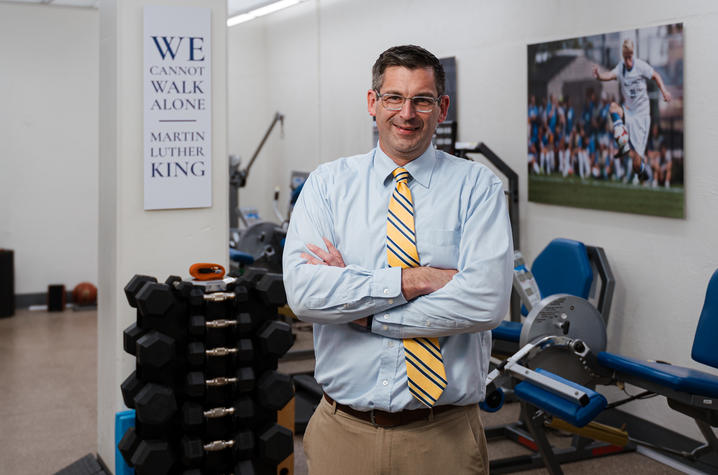
Brian W. Noehren, Ph.D., associate dean for research in the University of Kentucky College of Health Sciences and director of the Biomotion Laboratory, was recently awarded two separate grants from the National Institute on Aging of the National Institutes of Health (NIH) and the War Department to advance the science of injury recovery. Although the studies focus on different areas of the leg — knee arthritis and ankle fractures — they are united by a common goal: improving the “health span” and quality of life for Kentuckians and beyond.
“Musculoskeletal injuries take an immense toll on the well-being and livelihoods of people across the Commonwealth,” said Phillip Gribble, Ph.D., dean of the College of Health Sciences. “Dr. Noehren’s research exemplifies our college’s mission to translate innovative science directly into meaningful solutions for Kentuckians and beyond.”
Connective tissue
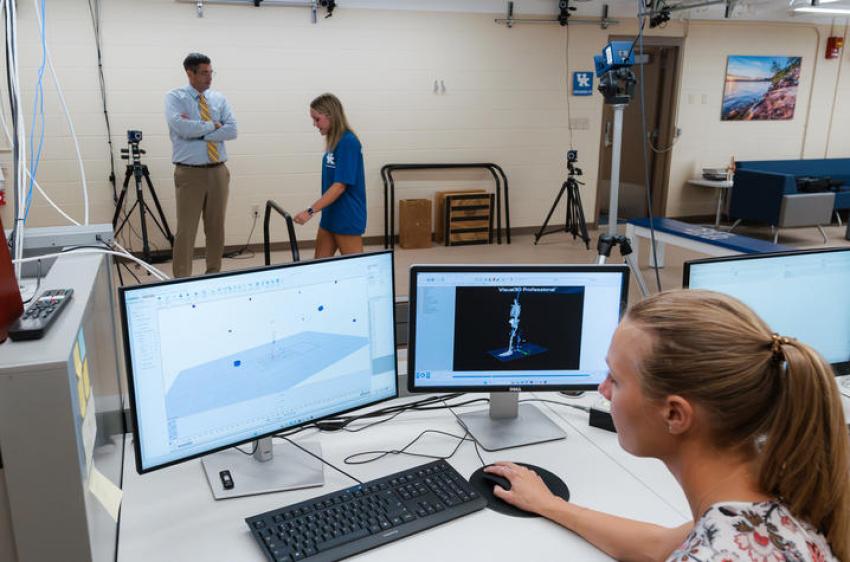
Though the two grants focus on different joints and demographics, Noehren sees them as two sides of the same coin: the development of novel tools to restore function in people suffering from traumatic injuries and chronic pain in their legs.
The lab’s research includes everything in the development cycle, from basic science to clinical application. For example, in close collaboration with Chris Fry, Ph.D., Noehren is testing ways to measure changes in muscle composition after an injury or a diagnosis like arthritis. The intended result: new interventions tailored to people’s specific biology.
Precision medicine for knee arthritis
The first of the two new studies, funded by the NIH, focuses on developing noninvasive muscle imaging biomarkers for individuals diagnosed with knee arthritis. Arthritis of the knee is one of the most common sources of disability for older individuals, often reducing their ability to remain active during retirement.
Current rehabilitation protocols for arthritis often follow a one-size-fits-all approach, but Noehren’s team is working toward a more precision-based methodology.
“Your biology is really different than my biology,” Noehren said. “Can we come up with a quick screening that’s noninvasive and provides personalized data to a clinician, who can then figure out a custom plan tailored to what that person really needs? One person may need an aerobic program, or another may need a strengthening type of program to reverse the changes in the muscle that are limiting function.”
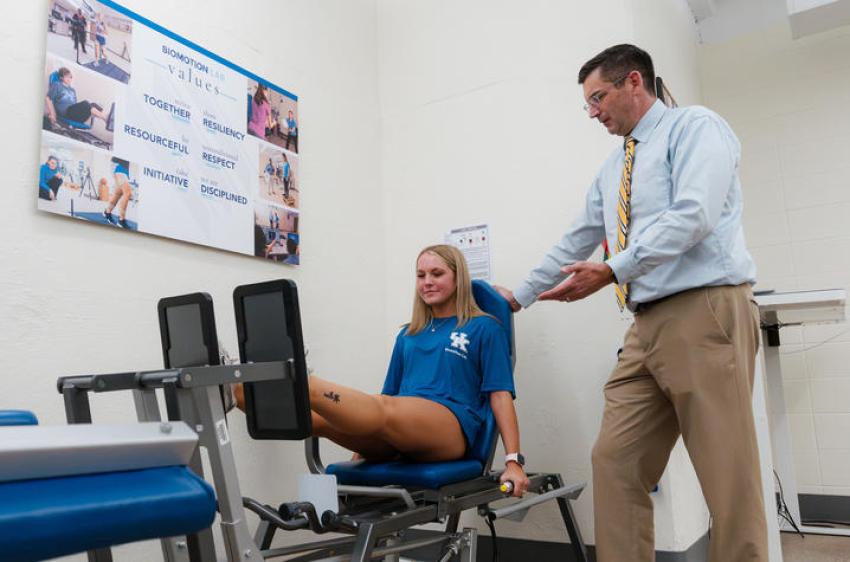
The study utilizes rapid MRI scans, lasting only five to 10 minutes each, to analyze muscle composition. The goal is that this information will allow clinicians to tailor exercise programs to a patient’s unique biological makeup, helping them stay active and maintain long-term physical function.
Ankle fractures
The second study, funded by a War Department Congressionally Directed Medical Research Program grant, addresses the long-term impact of ankle fractures. This research is particularly vital for the military. When a service member fractures an ankle, it severely impacts operational readiness for the whole unit.
“Here in Kentucky, we have the 82nd Airborne in Fort Campbell,” Noehren said. “If a soldier breaks an ankle while doing a jump and cannot recover to make it back to his unit, it reduces the whole unit’s operational effectiveness needed to carry out their mission.”
The impact of this study extends far beyond the military. The research is open to civilians because UK, as an R1 research institution, has a robust trauma group that sees a high volume of these injuries. Approximately 50% of people who suffer an ankle fracture will go on to develop chronic pain, and many struggle to return to work, especially in industrial sectors.
For example, if a worker at a facility like Georgetown’s Toyota Motor Manufacturing Kentucky breaks an ankle over the weekend, the ability to return to the factory floor is critical for their livelihood. This study represents the first clinical trial designed to develop specific treatment guidelines for these patients, who currently have no standardized path for recovery.
Team science
Noehren emphasizes that these high-level studies are the result of team science. The research involves a diverse group of experts working together:
- Darren Johnson, M.D., professor of orthopedic surgery in the UK College of Medicine, UK HealthCare orthopedic surgeon, sports medicine physician and team doctor for UK Football
- Austin Stone, M.D., Ph.D., associate professor of orthopedic surgery in the UK College of Medicine, UK HealthCare orthopedic surgeon, sports medicine physician and team doctor for several UK Athletics programs
- Paul Matuszewski, M.D., associate professor of orthopedic surgery, vice chair of research and director of orthopedic trauma research in the UK College of Medicine
- Chris Fry, Ph.D., professor of athletic training and clinical nutrition and co-director of the Center for Muscle Biology in the UK College of Health Sciences
- Meredith Owen, Ph.D., bioengineer and assistant professor in the department of physical therapy in the UK College of Health Sciences
- Lauren Erickson, D.P.T., Ph.D., assistant professor in the department of physical therapy in the UK College of Health Sciences and a clinician in the BioMotion Laboratory
“There’s no one else in the United States that has the capabilities that this group does in terms of expertise in muscle biology, biomechanics, physical therapy, orthopedic surgery, engineering — all in one shop,” Noehren said.
This multidisciplinary approach allows the team to ask questions and find solutions that other labs cannot. Whether it’s helping a parent in their 50s stay active with their high school-aged children or helping a soldier return to duty, the research is designed to have a direct, positive impact on the local community.
Impact on the Commonwealth
The ultimate goal of this work is to ensure that Kentuckians can lead healthier, more productive lives. By providing better tools for screening and rehabilitation, UK researchers hope to reduce the burden of chronic pain and disability that currently plagues the state.
“I hope that people in the Commonwealth see that there’s some amazing science happening here at UK,” Noehren said. “These are high-level studies that are being funded by the Department of War and NIH that will directly affect people here in Kentucky.”
Beyond the two studies funded by these grants, Noehren’s lab continues to explore other avenues of musculoskeletal health, including how men and women recover differently after ACL reconstructions and using wearable insoles to help patients properly load their limbs after fractures. The central theme remains the same: using science to help Kentuckians.
Research reported in this publication was supported by the National Institute on Aging of the National Institutes of Health under Award Number R01AG093616. The content is solely the responsibility of the authors and does not necessarily represent the official views of the National Institutes of Health.
Research reported in this publication was supported by a $1,499,334 grant from the Department of War under Award Number HT94252510625. The content is solely the responsibility of the authors and does not necessarily represent the official views of the Department of War.
UK HealthCare is the hospitals and clinics of the University of Kentucky. But it is so much more. It is more than 10,000 dedicated healthcare professionals committed to providing advanced subspecialty care for the most critically injured and ill patients from the Commonwealth and beyond. It also is the home of the state’s only National Cancer Institute (NCI)-designated Comprehensive Cancer Center, a Level IV Neonatal Intensive Care Unit that cares for the tiniest and sickest newborns and the region’s only Level 1 trauma center.
As an academic research institution, we are continuously pursuing the next generation of cures, treatments, protocols and policies. Our discoveries have the potential to change what’s medically possible within our lifetimes. Our educators and thought leaders are transforming the healthcare landscape as our six health professions colleges teach the next generation of doctors, nurses, pharmacists and other healthcare professionals, spreading the highest standards of care. UK HealthCare is the power of advanced medicine committed to creating a healthier Kentucky, now and for generations to come.