RHB Student Earns $50K National Research Award to Advance Amputation Recovery
Nov 9, 2026
By Ryan Clark
CHS Communications Director
For Hannah Young, PT, DPT, helping patients recover after lower-limb amputation means looking beyond physical rehabilitation.
The third-year doctoral student in the College of Health Sciences' Rehabilitation and Health Sciences PhD program is studying how confidence — or self-efficacy — influences recovery, a topic she hopes can improve outcomes for patients navigating one of life’s most significant challenges.
Her work recently received a major boost.
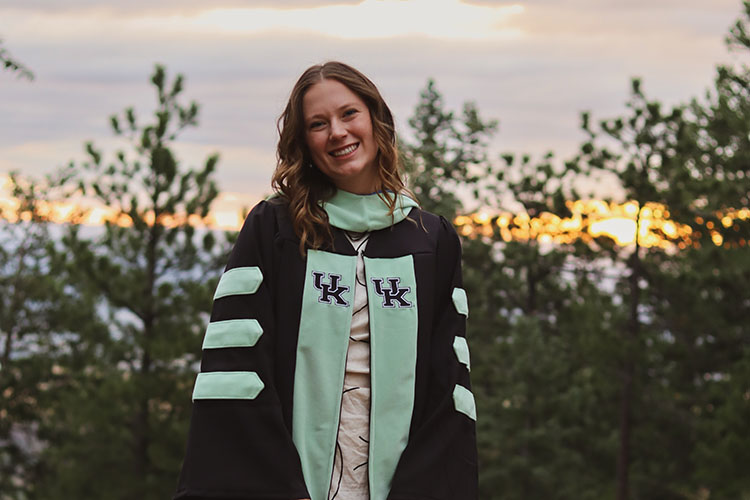
Young, who is also an alumna of UK’s Department of Physical Therapy, recently traveled to Baltimore, Maryland, to receive the 2026 Mobility is Freedom-PhD Scholar Award, a nationally competitive research grant providing $50,000 to support her project, Facilitating Optimal Care Through Understanding Self-Efficacy After Lower-Limb Amputation (FOCUS-ALL).
The award will fund two years of research, which started July 1.
“I am honored to receive an award of this magnitude,” said Young, 26, of Glenwood Springs, Colorado.
Young’s research centers on self-efficacy, a psychological concept that describes an individual’s belief in their ability to successfully complete a task. While self-efficacy has been shown to improve outcomes in several patient populations, Young says it remains understudied among individuals recovering from lower-limb amputation.
“My research focuses on the psychological concept of self-efficacy and its impact on recovery following lower-limb amputation,” she said. “This population has a higher mortality rate and poorer functional outcomes than many other patient populations, which presented an opportunity to explore a novel approach that can complement standard rehabilitation and recovery.”
Her project seeks to better understand how self-efficacy affects rehabilitation and whether strengthening it can ultimately help patients achieve better functional outcomes and quality of life.
Young’s path to research began while she was pursuing her Doctor of Physical Therapy degree at UK. During her second year, she attended the American Physical Therapy Association’s Combined Sections Meeting in San Diego, where a panel discussion introduced her to career opportunities beyond clinical practice.
“I realized I had a drive to continue learning and educating myself to help advance the physical therapy profession through scholarship and research,” Young said.
That experience, combined with conversations with faculty mentors and exposure to doctoral students within the College of Health Sciences, inspired her to continue her education through the Rehabilitation and Health Sciences PhD program.
“I was drawn by the outreach and community service opportunities in the physical therapy program,” Young said. “While still in PT school, I got to interact with faculty and students in the PhD program and saw another side of physical therapy that really intrigued me.”
She also credits the college’s collaborative environment for reinforcing her decision to stay at UK.
“The collaboration and interdisciplinary experiences I had while in physical therapy school made me realize how much the College of Health Sciences values those connections,” Young said. “That aligns with what I value as a clinician, student and researcher. It was an easy decision to continue my education here.”
“We are very proud of Hannah’s recognition through receipt of this award,” said Patrick Pabian, PT, DPT, PhD and chair of the Department of Physical Therapy. “Her achievement is a testament to her strong work ethic as well as the guidance she has been receiving throughout the RHB program and direct mentorship by her research mentor, Dr. Sheila Clemens from the Department of Physical Therapy.”
“I am extremely proud of Dr. Young for receiving this prestigious and highly competitive research grant,” said Esther Dupont-Versteegden, PhD and director of the Rehabilitation Sciences PhD Program.“PhD students may receive training grants they have written, but very few will be awarded actual research grants. It is a huge honor and reflects the hard work she and her advisor have put into her research, and I am happy that her education in the Rehabilitation and Health Sciences PhD Program has allowed her to be competitive for this opportunity.”
As her research continues, Young says she hopes her work will contribute to improving care for people living with limb loss while encouraging future clinician-scientists to pursue research careers of their own.
Her advice to students considering a similar path is simple: surround yourself with people who will help you grow.
“Find mentors who have your best interest in mind throughout the process,” Young said. “I would not be where I am today without the mentors I had in physical therapy school and the ones I have gained in the PhD program. It takes a village.”
She also encourages students to prioritize life outside the classroom and laboratory.
“You can only give so much before reaching burnout and not being able to give your best effort,” she said. “You have to care for yourself in order to care for others.”
Young says the friendships she has built throughout the PhD program have also been instrumental in her success.
“I am so grateful for the friendships I have made in the PhD program,” she said. “Having those moments where we can relate to each other makes the process feel a lot less overwhelming and stressful.”
For Young, receiving the Mobility is Freedom Scholar Award is both an affirmation of her work and motivation to continue asking questions that can improve patient care.
With support from the nationally recognized award, she hopes the findings from the FOCUS-ALL study will help shape future rehabilitation strategies for individuals recovering from lower-limb amputation and ultimately improve lives through research-driven care.
“This is an amazing opportunity to continue researching and giving back to patients,” she said.