A Lasting Impression: More than a Year after Dr. Mary Jo Cooley-Hidecker’s Death, Plaque Honors Her Legacy
Apr 6, 2026
By Ryan Clark
CHS Communications Director
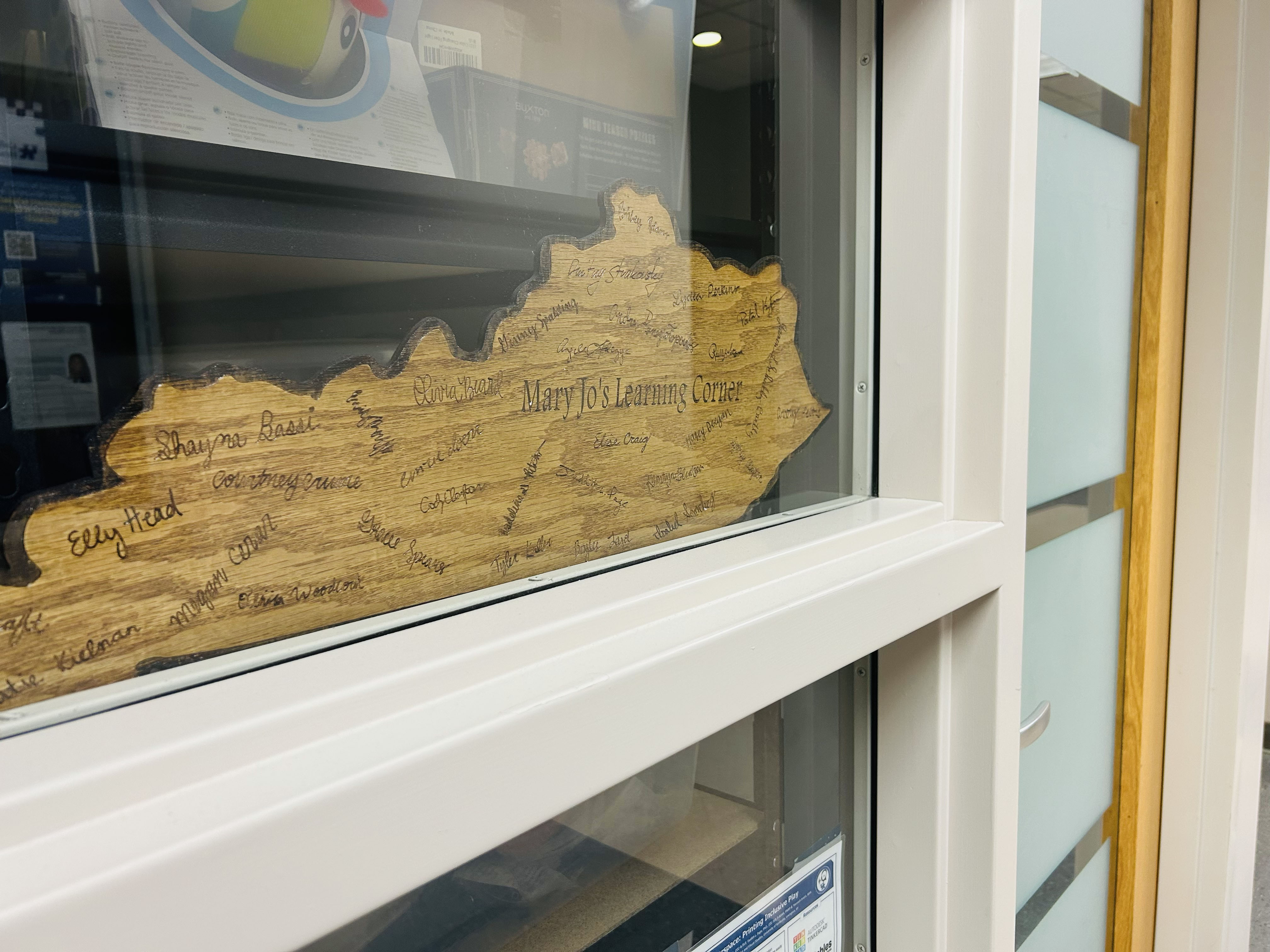
On the second floor of the Charles T. Wethington Building, a wooden sign hangs just inside the window of the College of Health Sciences Rehab Makerspace Lab. In the shape of Kentucky, it’s simple in form, but layered with meaning.
Covered in etched signatures of students, faculty and friends, the piece serves as a quiet, enduring tribute to Dr. Mary Jo Cooley-Hidecker, whose vision helped bring the Makerspace to life and whose impact continues to shape it.

Cooley-Hidecker, 66, died Feb. 11, 2025, surrounded by family in Lexington. An associate professor in the Department of Communication Sciences and Disorders and the Rehabilitation and Health Sciences PhD Program in CHS, she built a career defined by interdisciplinary collaboration, innovation and advocacy for people with disabilities.
And the sign reflects that legacy.
“I think the tribute sign is a true representation of Mary Jo’s life work for people with disabilities,” said Janine Schmedding-Bartley, PhD, CCC-SLP. “She spearheaded bringing faculty together from across campus to develop the CHS Makerspace and allowed us to produce adapted communication aids, functional tools and play solutions.”
The Makerspace, co-created by Cooley-Hidecker and physical therapy professor Dr. Patrick Kitzman, was designed as a collaborative hub. Students and faculty use technologies such as 3D printing, laser engraving and soldering to design customized tools that improve daily life for individuals with disabilities.
For those who worked alongside her, the sign is more than a memorial — it is a continuation of her mission.
“The beautiful plaque represents all of the different facets of our work in the Makerspace,” Schmedding-Bartley said. “It was created with technology used in the Makerspace and represents the students, faculty and friends that Mary Jo influenced.”
Kitzman said the idea for the tribute grew out of a desire to create something lasting within the space she helped build.

“Janine, Judy Page and myself felt it was important to recognize Mary Jo since she was the co-creator of the Makerspace,” he said. “I had wanted something we could hang in the lab.”
Inspired by a similar piece he had seen honoring a retiring colleague, Kitzman said the group sought to create something equally meaningful and fitting for a Makerspace environment.
“So, we got all the current students to provide their signatures, plus some former students and other key people who were instrumental in the creation of the Makerspace program,” he said.
Those signatures now form a collective expression of gratitude, etched into wood, a material as enduring as the influence Cooley-Hidecker had on those around her.
Her career spanned clinical practice, research and education. Trained as a speech-language pathologist, audiologist and epidemiologist, she focused on improving communication outcomes for individuals with complex disabilities. Her work emphasized family-centered, evidence-based care, with research exploring conditions such as cerebral palsy, autism, hearing loss and Parkinson’s disease.
She led development of the Communication Function Classification System, now used internationally, and contributed to interdisciplinary efforts advancing autism classification frameworks. In 2024, she was named a Distinguished Scholar and Fellow by the National Academies of Practice, recognizing her commitment to interprofessional collaboration.
But colleagues say her greatest impact may have been in mentorship.
Cooley-Hidecker worked with students at every level — from high school to doctoral programs — encouraging curiosity and compassion. She was known for a simple but persistent challenge: keep asking “Why?”
That spirit lives on in the Makerspace, where students continue to question, design and build with purpose.
For College of Health Sciences Dean Scott Lephart, PhD, the sign reflects something deeper than remembrance.
It represents community.
“Every person passing by can look at that wonderful reminder and remember how much Mary Jo gave to the lab and the College,” Lephart said. “And it is that kind of community, the kind that wants to do something like this, that we all want to be a part of, and that makes me so proud to work here in the College of Health Sciences.”