Mission
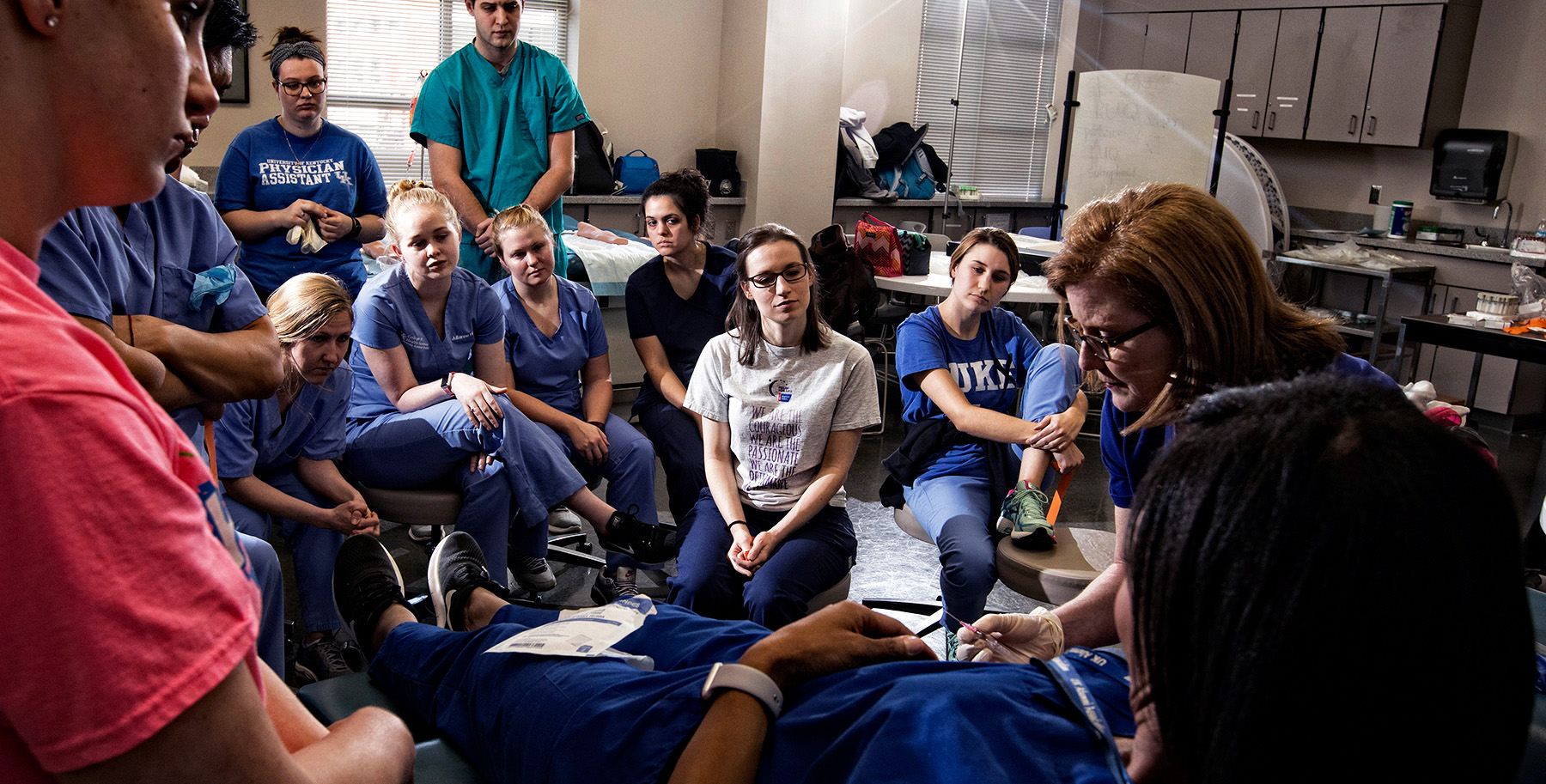
The University of Kentucky Physician Assistant (PA) Program's mission is to educate highly skilled, compassionate physician assistants trained to provide exceptional patient care and advance healthcare in underserved and rural communities across the Commonwealth of Kentucky.
Our program's success in fulfilling this mission is founded on:
- Rigorous academic training
- Active community engagement
- A collaborative environment fostering care for others, innovation, leadership, and excellence.
Values
- Leadership
- Life-long Learning
- Collaboration and Partnership
- Ethical and Professional Behavior
- Advancement of medical knowledge
- Quality, Safe and Accessible Healthcare
UKPA Program Goals (A3.11b, 6th Ed.)
The University of Kentucky Physician Assistant Studies Program reviews program goals and outcome benchmarks annually as part of ongoing program assessment efforts. The outcome data below reflect aggregated results from the Classes of 2023–2025. In addition to an annual review of goal attainment, the program conducts a comprehensive review of program goals and benchmarks every three years to ensure continued alignment with the program's mission, workforce needs, and overall program outcomes.
GOAL #1
Recruit and retain highly qualified students who complete medical education training as a UK Physician Assistant.
The University of Kentucky Physician Assistant Studies Program evaluates this goal using student retention, graduation, and student support measures.
| Measure | Program Benchmark | 2023-2025 Outcome | Benchmark Met |
| Graduation Rate | ≥90% | 93.8%–100% | Yes |
| Attrition Rate | 3–7% | 0%–6.2% | Yes |
| Student Support & Faculty Availability Ratings | ≥3.0 / (4.0pt scale) | 3.12–3.55 | Yes |
Summary: Results across the Classes of 2023–2025 demonstrate strong student retention, high graduation rates, and positive student support outcomes across both campuses. Survey responses were captured using the program’s Curriculum and Administrative Aspects (CAA) instrument.
GOAL #2
Administer a comprehensive academic program that provides students with the knowledge and skills necessary for entry-level practice as a physician assistant.
The University of Kentucky Physician Assistant Studies Program evaluates this goal using measures of curricular effectiveness, summative performance, and interprofessional education participation.
| Measure | Program Benchmark | 2023–2025 Outcome | Benchmark Met |
| Student Perception: Curriculum Effectiveness (CAA and Exit Surveys) | ≥3.0 (4.0pt scale) | Improved from 2.91 (2023) to 3.40 (2025) | Partially Met |
| Summative Evaluation Performance | ≥70% passing standard | 89%–91% first-time pass rate in recent cohorts | Yes |
| Interprofessional Education Participation | Required participation | 100% participation | Yes |
Summary: Results demonstrate improvement in curriculum effectiveness, strong summative performance, and continued preparation of students for entry-level clinical practice.
GOAL #3
Encourage and prepare graduates to provide care for those who are medically underserved or reside in rural areas in Kentucky and beyond.
The University of Kentucky Physician Assistant Studies Program evaluates this goal using graduate workforce outcomes, including practice in rural communities and federally designated underserved areas, defined as Primary Care Health Professional Shortage Areas (HPSA) and Medically Underserved Areas/Populations (MUA/P). Data are collected through analysis of graduate licensure and workforce location data
| Measure | Program Benchmark | 2023–2025 Outcome (Aggregated) | Benchmark Met |
| Graduates practicing in rural and/or underserved settings (Primary Care HPSA and/or MUA/P) | ≥40% | 45% | Yes |
Summary: Analysis of graduate workforce location data demonstrates strong alignment with the program’s mission to prepare graduates to serve rural and medically underserved populations. Using a composite measure of graduates practicing in rural areas and/or federally designated underserved areas: Primary Care Health Professional Shortage Areas (HPSA) and Medically Underserved Areas/Populations (MUA/P), 72 of 161 graduates (45%) meet at least one criterion, exceeding the ≥40% benchmark.
Supporting data show 62 (39%) in HPSAs, 47 (29%) in MUA/Ps, and 41 (25%) in rural communities. Morehead graduates demonstrate particularly strong alignment, with 28 of 42 (67%) practicing in rural and/or underserved settings.
GOAL #4
The UKPAS Program’s faculty and staff will provide excellence in teaching, service, and scholarship.
The University of Kentucky Physician Assistant Studies Program evaluates this goal using student evaluations, student survey data, institutional review processes, and measures of scholarly and professional engagement.
| Area | Data Source(s) | Timeframe | Evidence of Goal Achievement |
| Teaching | Teacher Course Evaluations (TCE), Student Exit Survey | Classes of 2023–2025 | Student evaluations of instruction consistently exceeded program benchmarks across cohorts. |
| Student Support & Program Contribution | Curriculum and Administrative Aspects (CAA) Survey | Student ratings related to faculty and staff contribution consistently met or exceeded program benchmarks. | |
| Service | Faculty institutional and professional service activities | Past 5 years | Faculty and staff maintained sustained involvement in institutional governance, professional leadership, and clinical service activities at the university, state, and national levels. |
| Scholarship | Publications, presentations, and grant activity | Past 5 years | Faculty and staff demonstrated ongoing scholarly engagement by disseminating academic and professional work at regional and national levels. |
Summary: Results demonstrate sustained excellence in teaching, service, and scholarship, supported by strong student feedback, professional engagement, and scholarly productivity. Findings are evaluated longitudinally using Teacher Course Evaluations (TCE), Curriculum and Administrative Aspects (CAA) survey data, institutional performance reviews, and aggregated scholarship and service activity, with outcomes compared against established program and institutional benchmarks.